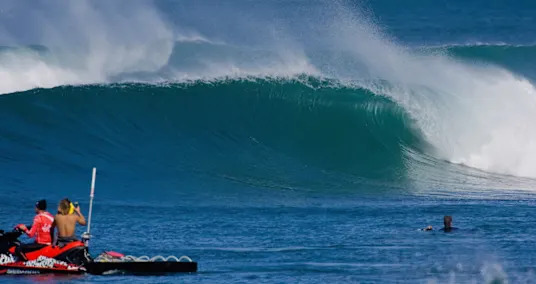
This iconic right-hand, point-break is nestled in an ideal location on the Surf Coast of Victoria to harness both wind and swell. Its reliable conditions have established it as a world-class competition venue and a treasured home-break for countless surfers over the decades. In this article, I'm going to dive into the key elements that have made this wave so legendary.
Swell Source
The Southern Ocean stretching between Australia and Antarctica, and extending west into the South Indian Ocean, is one of the most active zones on the planet for storm activity. These storms are strongest and most frequent from April through September (the Southern Hemisphere's winter months), but swell-producing systems can develop at any time of year.

Swell Window
Storms that develop a strong and well-aimed fetch between 224° SW and 196° SSW are ideal for Bells, as there are no obstructions for inbound swell. Due to the orientation of Bells (generally facing southeastward), incoming swell west of 224° will feel a degree of shadowing by Australia itself - the more west, the more it will be shadowed, and therefore less energy making it into Bells. Swells east of 196° will feel partial shadowing by islands off the coast of Tasmania, then blocked by Tasmania east of 175°.

Bathymetry
An offshore underwater ridge stretching to the south will help to refract a greater share of the inbound swell toward the gradually rising rock reef at Bells. While it isn’t a classic point break, the waves often act like one—concentrating their energy at the top of the reef where it peaks. From there, the local bathymetry takes over, guiding the swell as it refracts from the deeper bay into the shallower reef along the point, producing the long, clean right-hand lines Bells is known for.

Long-period swell (over 15-16 seconds) interacts more effectively with the bathymetry, allowing the energy to focus and wrap into the break with greater precision.
The ideal swell direction for shape falls between 215° and 196°. Swells arriving from farther west tend to produce flatter faces and break wider on the outside reef, missing the famed end bowl section. These conditions are often better suited to Winkipop, Bells’ neighboring break to the east.
When the swell comes from a more southerly angle, it strikes the top of Little Rincon—the section of reef directly below the Bells cliff—more directly. This produces a steeper, more hollow wave throughout, though it can also be faster and more sectiony down the line.

Wind
Given the general southeasterly exposure of the beach, straight offshore is from the northwesterly direction. Light to moderate offshore flow from the west through northwest is ideal, or calm to light/variable wind for glassy surface conditions.
High-pressure positioned to the north over New South Wales or Queensland, with its counterclockwise circulation, will deliver west to northwest winds to Bells.
While offshore for some other locations in the area, a N to NE wind is a “devil wind” at Bells and Winkipop, especially when moderate to strong. A light wind from the straight N is OK.

Best Specs
Swell Direction: SW to SSW (215-196°)
Swell Period: 15-16 seconds or longer
Surf Size: Chest-high to triple overhead
Wind: West to northwest
Tide: Low for the Bells Bowl and high for Rincon
This story was originally published by Surfer on Apr 2, 2026, where it first appeared in the News section. Add Surfer as a Preferred Source by clicking here.
LATEST POSTS
- 1
 IDF kills four terrorists equipped with weapons, surveillance gear near Gaza's Yellow Line
 - 2UN torture cm'tee report flags Israel for allegedly mistreating journalists, detainees, ex-MAG
- 3Figure out How to Use the Experience of a Fender bender Legal counselor for Your Potential benefit
- 4EU Commission slams Israel's death penalty law for Palestinians
- 5Flu season is underway. What are common symptoms to watch for?




- German journalists' union condemns attack on reporters in village
- The Best Games On the planet
- Tzrifin base exhibition reveals Hamas and Hezbollah arms, showing structure behind attacks
- Vote In favor of Your Favored Web-based Book Retailor
- Genetic study identifies earliest-known dog, dating to 15,800 years ago
- Activists guilty over Palestine protest breach
- What is Fusarium graminearum, the fungus a Chinese scientist pleaded guilty to smuggling into the US?
- Home Security Frameworks with Shrewd Elements
- Washington state experiences historic flooding as Skagit River hits record high level. See flooding maps, highway closures and forecasts.